
Between System and Soul
The necessary tension between institutional care and community-based death doula work

I haven’t published here for awhile. I have been busy but it has been too long! I have written before about sacred imagination, presence, and the recovery of what our culture forgets. I have not written much about death work, though it has quietly become one of the places where those convictions have grown deeper roots. This feels like the right place to begin.
There is a kind of service that can only remain honest if it stays a little outside the system.
I have been learning that firsthand.
Over the past year, I have regularly volunteered on an inpatient hospice unit while also completing my Deathwalker End-of-Life Doula certification under the mentorship of Jade Adgate. Standing in both places at once—inside a hospice setting, yet formed by a community-based doula tradition—has brought one conviction into sharper focus for me:
Death doulas must remain community-based.
For many of you, this may feel like a new subject for CowboyMonk. It is, at least on the surface. I have mentioned that I work around death, but I have not written much about it directly. Maybe that is because death, like the sacred, does not yield itself to quick language. It asks for reverence. It asks for honesty. It asks us to slow down enough to see what is really there.
And that, to me, is part of sacred imagination.
Sacred imagination is not fantasy. It is the recovery of our capacity to see reality more truthfully, especially in the places modern life has trained us to avoid. Death is one of those places. The dying are not problems to solve. They are human beings at a threshold. To accompany that threshold well requires presence, courage, and a kind of freedom that does not belong entirely to institutions.
Jade recently wrote about stepping away from a hospice where she had volunteered for years after learning the organization planned to launch its own fee-based death doula training program. Her piece named a question I think our field must take seriously:
If death doulas are meant to help de-medicalize and re-humanize dying, what happens when the medical system begins defining and training the role for itself?
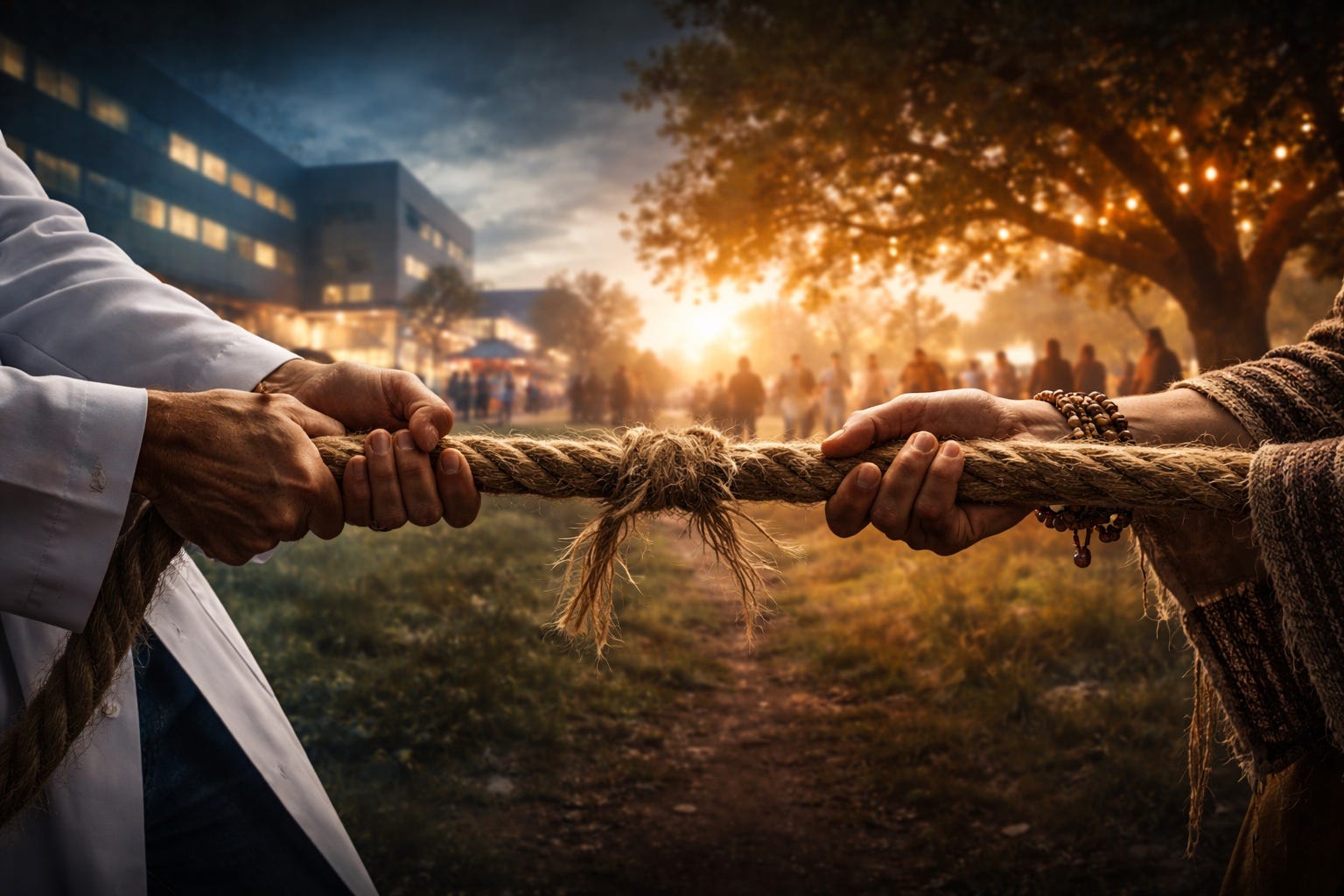
Hospice and doula work can complement one another beautifully, but they are not the same thing. Hospice is a medical institution, shaped by regulations, systems, liability, workflow, and institutional culture. Death doulas emerged largely outside that framework, in the places where families needed more listening, more time, more advocacy, more explanation, and more humanity.
That difference matters.
It matters because sometimes nurses need to be questioned.
Not attacked. Not dishonored. But questioned.
Sometimes families are confused. Sometimes things move too quickly. Sometimes the logic of the institution overtakes the pace of the person. Sometimes the room begins to belong more to process than to presence. In those moments, it matters that someone at the bedside is free enough to ask another question.
That freedom becomes less likely when the role itself has been absorbed by the system it may need to challenge.
This is what I find so compelling in Jade’s argument. The danger is not only that hospices may duplicate doula training. The deeper danger is that they may slowly redefine the role. Advocacy can soften into compliance. Presence can become programmatic. The doula may still carry the title, while losing the independence that gives the work much of its integrity.
Because the death doula is not there first to protect the institution.
The death doula is there to protect the human scale of dying.
Sometimes that means silence.
Sometimes it means translation.
Sometimes it means sitting with fear long enough that it no longer has to perform.
Sometimes it means helping a family trust what they are seeing.
Sometimes it means saying, gently and clearly, that something needs another look.
That kind of care requires closeness, but it also requires independence.
I say that not as a critic from the outside, but as someone who has seen the inpatient unit from within. The more closely I have watched the system work, the more grateful I have become for roles that are not entirely governed by it. Not because the system is bad, but because every system has limits. Even compassionate institutions have blind spots. Even good people become shaped by pressure.
Community-based doulas help preserve the human texture of dying.
They remember that a dying person is not a chart, a room number, or a workflow issue. They remember that families are often trying to make meaning while the ground is moving beneath them. They remember that the emotional, spiritual, symbolic, and communal dimensions of death do not fit neatly inside clinical categories. They remember that the soul has a pace of its own.
I will also be stepping away from my role as a volunteer at the same hospice.
In this next season, I plan to return to volunteering as a chaplain at a local hospital, where my wife also works as an occupational therapist. I hope to start a conversation with the head of their volunteer program and explore whether there may be ways death doulas could serve there too.
But only, I hope, in a way that preserves the integrity of the role: community-based, collaborative, and free enough to remain truthful.
That feels like the future worth protecting.
As one of Jade’s students, and now one of her certified peers, I am grateful for her willingness to say aloud what many may feel but hesitate to name. Her piece is not just about one hospice organization. It is about a larger crossroads in the life of this emerging profession.
Who trains doulas?
Who defines their scope?
Who protects their independence?
Who makes sure advocacy does not quietly become institutional loyalty?
These questions matter because dying people matter.
And perhaps this is one more place where sacred imagination is needed: the willingness to remember that death is not only a medical event, but a human passage. Not only a process to manage, but a threshold to honor.
The bedside must remain human.
And sometimes the best way to keep it human is to stay near enough to love, and free enough to speak.
For the fuller context behind some of what I’ve shared here, I encourage you to read Jade’s thoughtful article:

Perfectly articulated and so well thought out. Thank you.
💯💯💯